

Nepal, already widely recognized as a country likely to feel climate change’s impacts the strongest, experienced a catastrophic flood after an ice chunk as large as the Empire State Building broke off of a glacier at the Nepal-Tibet border.

To give an idea of how powerful the phenomenon was, it was first classified as a 5.2 magnitude earthquake by the US Geological Survey before they then clarified that it was the result of a glacier collapse. The ice chunk broke off a glacier in the mountains and fell roughly 7,000 feet into the Lhende Khola River. Daniel Shugar, a Canadian geologist, explained that “the sheer force of the collapse melted the ice, and on its way, the torrent also picked up other waterlogged sediment”. The flood covered 14 miles in less than 7 minutes, causing many to be unaware of the danger. 797 people have been confirmed dead, while the latest numbers estimate 3,048 people missing. Citizens from India, the US, Ukraine, Malaysia, Australia, Britain, and other countries have also been reported missing. The area was heavily populated with employees working on local infrastructure projects, tourists planning to trek in the mountains, and religious travelers visiting Mount Kailash and other sacred sites.
International governments and organizations have already pledged money for both immediate support and long-term recovery aid. The World Bank has pledged roughly $160 million, Canada $5 million, the US $3.6 million, the European Union $2.3 million, the UN $2.5 million, and the Asian Development Bank $5 million, to name a few. However, the estimated recovery cost for Nepal is 4 to 5 billion. In a show of national unity, the prime minister and all cabinet members donated one month’s salary to the Prime Minister’s Disaster Relief Fund; together, with private corporation and citizen donations, the fund raised roughly $38 million.
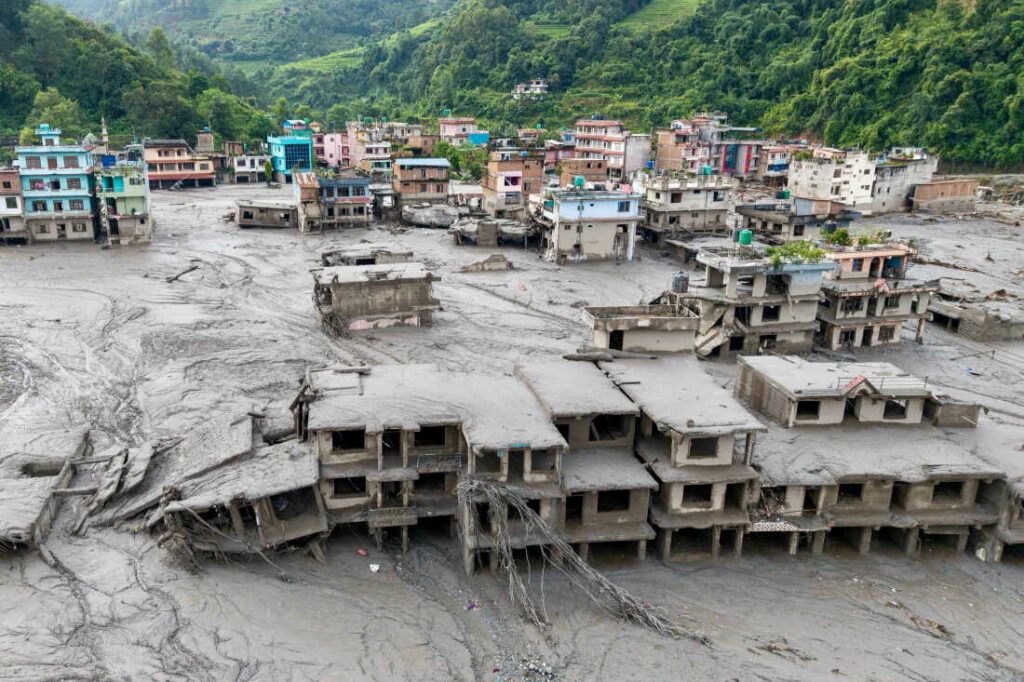
China’s response to the disaster has drawn international scrutiny. Tibet’s rocky history with the country, originating from religious differences, has led to heavy censoring of the majority of news related to the area. Videos have been released by state media of rescue teams searching for survivors in the hardest-hit areas, but little of the information available for the rest of the world is accessible for Chinese citizens. Hours after the disaster took place, China encouraged its local Communist Party members to “make every effort to maintain social order and ensure stability and public confidence in the disaster areas”. People who did not would be “held accountable”. The International Campaign for Tibet denounced Beijing for removing “videos and other first-hand information from social media”, making it harder for people outside the affected Tibetan region to know what happened to their family and friends.
The Nepal-Tibet flood remains another warning of the increasing danger climate change poses to our lives, but also shows how countries can still come together during times of crisis for the betterment of all citizens.