For years, Apple fans (and I) have watched other companies fold their phones in half and wondered the same thing: When will Apple finally do it? In 2026, the answer finally arrived. At Apple’s September event, the company introduced the iPhone Duo, its first-ever foldable iPhone, alongside the iPhone 18 Pro and Pro Max. But this wasn’t just another September product launch. It was the beginning of a new chapter for Apple. The event marked the first major iPhone launch under new chief executive officer John Ternus, while also closing the book on Tim Cook’s fourteen-year run as CEO.
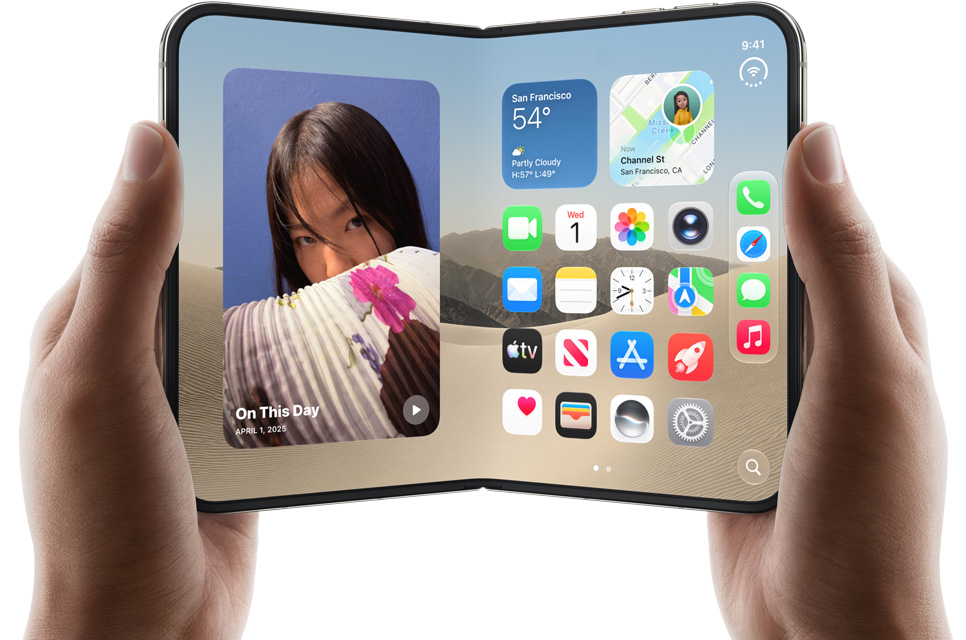
The star of the event was obviously the iPhone Duo. Fold it shut, and it looks like a compact, passport-shaped iPhone with a 5.4-inch outer display. Open it, and suddenly you’ve got a giant 7.6-inch screen. It’s the largest display ever put into an iPhone. It’s also just 5.2 millimeters thick when unfolded, making it Apple’s thinnest iPhone ever. But the most interesting part may be something that Apple barely wants you to notice: the crease.
Foldable phones have existed for years. Samsung introduced its Galaxy Fold back in 2019, and companies such as Google, Motorola, Huawei, and others have spent years experimenting with folding displays. So Apple is not inventing the foldable-phone category. It’s arriving late. That makes the Duo’s design especially important. Apple has attempted to make the foldable experience feel less like a compromise and more like an ordinary iPhone that happens to open into something much larger. The inner screen uses a special nano-texture finish that reduces reflections and glare while also making the crease far less noticeable. Apple says the surface minimizes the crease’s visibility, and early reviewers generally agreed that the crease is difficult to see, although it can still be felt and may become visible under certain lighting.
That’s where the “Apple effect” becomes interesting. People aren’t reacting to the Duo simply because it is a foldable phone. Foldable phones have been around for years. They’re reacting because it’s a foldable iPhone (hence the “Apple effect”). Apple has created an ecosystem in which a new product can immediately become part of millions of people’s existing digital lives. The same Apple ID, apps, messages, AirPods, Apple Watch, iCloud data, and familiar iOS interface can follow a person onto the new device. The Duo also brings features designed around its unusual shape, including multitasking across the larger display. In other words, Apple isn’t simply selling a screen that folds. It’s selling the idea of an iPhone that can transform depending on how it is being used.
Photo Credits: Apple
So far, the reaction has been enormous. At Apple stores, launch day excitement returned almost immediately. TechRadar described the atmosphere at Apple’s Fifth Avenue store as “electric”, with customers lining up for the iPhone 18 Pro launch and new CEO John Ternus greeting customers himself.
And then came the internet.
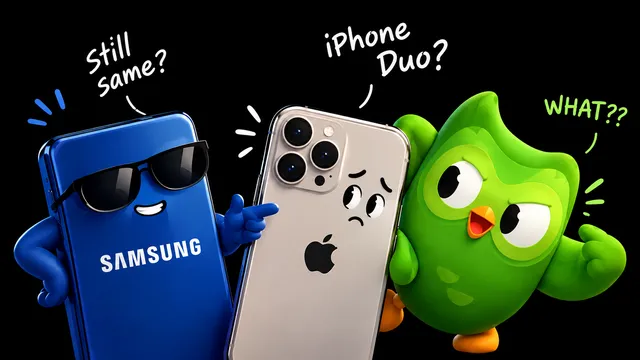
Samsung, which had been making foldables for years, wasn’t exactly going to watch Apple enter the category with a warm welcome. As the Apple event unfolded, Samsung Mobile US began posting sarcastic reactions on X. One of the sharpest read, “Let us know when you’re done reheating our leftovers.” Another simply asked, “Was it exciting? No. Did it happen? Yes.” Perhaps the biggest flex came when Samsung posted, “Making us wait? Fine. We’ll be over here, folding 3 ways,” referring to its own Galaxy Z TriFold.
But then the situation took an unexpectedly hilarious turn.The name Duo caught the attention of Duolingo, whose mascot is also known as Duo. The language-learning company posted, “They named a phone after me and made it bend over.” Samsung then jumped into the joke, telling Duolingo, “I’m so sorry, @duolingo. They copied us too #Solidarity.” Duolingo fired back with, “When an ugly stranger calls you twin.” Suddenly, what started as Samsung mocking Apple had turned into a three-way social media spectacle. The irony was basically perfect: Samsung had spent years trying to convince people that foldables were its territory, Apple had finally entered the market, and somehow the day-to-day language learning app became one of the funniest characters in the entire launch.
Photo Credits: afaqs!
And that reaction says something important about Apple. Samsung could point out, fairly, that Apple was entering a category Samsung had already helped build and revolutionize. But the moment Apple put its own version of a foldable on the stage, the entire technology world started going crazy about it. That’s the power of the iPhone brand. Apple doesn’t necessarily have to invent a category to completely change the conversation around it. Apple isn’t just a reputation; it’s the American legacy of inspiration through innovation in technology. The question is no longer simply whether foldables are useful. It becomes: What does a foldable look like when Apple makes one?
For now, though, one thing is clear. Apple’s 2026 event was about more than a phone that folds. It was about a company willing to boldly enter a category it had watched from the sidelines. The crease may be almost invisible, but the message behind it definitely isn’t. Apple has entered a new era. Now we just need to wait to see how they’re going to play (or should I say “fold”) their cards.